
Best Practices: Data Maintenance
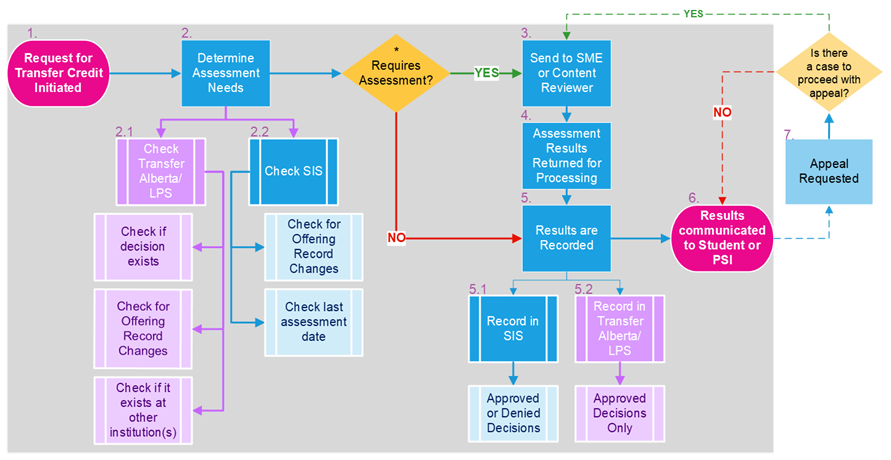
This diagram shows a typical workflow at a post-secondary institution when a student requests a transfer credit assessment.
Introduction:
- Steps 1-2: Alway completed, including sub-steps
- Steps 3-4: Only completed when an assessment is required
- Steps 5-6: Alway completed, including sub-steps
- Step 7: Only completed following an appeal request
________________________________________________________________
Step 1: Request for Transfer Credit Initiated
Transfer Credit Requests are received through form submission, email, or automatic process.
Step 2: Determine Assessment Needs
Check internal and external systems for previous assessment(s).
- Check Transfer Alberta/LPS Catalog
- Does the Transfer Credit Decision exist in the system?
- Has another institution previously awarded credit for the course/program?
- Check Student Information System (SIS)
- When was the course/program last assessed?
- Post-Secondary Institutions (PSI’s) will have different policies regarding the currency of the last assessment. This range is usually between 3-10 years.
- Has the course/program changed since it was last assessed?
- If the course/program has changed, how substantial are the changes
*Decision Point:
- Proceed to Step 3 if:
- The program has not been assessed or is outside your PSI’s course/program relevance and timeliness.
- The course/program has changed substantially
- Proceed to Step 5 if:
- The course/program has been previously assessed, aligns with your PSI’s policy on relevance and timeliness, and has had no substantial changes since the last assessment.
Step 3: Send Transfer Credit Request to Subject Matter Expert (SME) or Content Reviewer
Course/program requires assessment/re-assessment. Transcripts, course outlines, and other supporting documents are sent to faculty/content reviewers for assessment. If there have been substantial changes to the course/program, those details should also be included in the correspondence.
Step 4: Assessment Results Returned for Processing
Results of the assessment from the Subject Matter Expert (SME) or Content Reviewer reported.
Step 5: Results are Recorded
- Record in SIS: Approved or Denied Decisions are Recorded in Student Information Systems (SIS).
- Record in Transfer Alberta: Approved Decisions are Recorded in Transfer Alberta.
- This can be done individually in TCES, or through a bulk upload in DCAR.
Step 6: Results Communicated to Student or Post Secondary Institution (PSI)
Results from review process are released to the student through email, letter, or internal systems.
- If no credit is awarded, communication should include the decision rationale.
- Communication should include information about your institution’s appeal process.
- This is the end of Transfer Credit Assessment Process unless an appeal is requested.
Step 7 (Conditional): Appeal Requested:
An appeal is received through a form, email, or other internal systems by a student or post-secondary institution. The appeal should include additional information/evidence for re-evaluation.
- Is there a case to proceed with the appeal?
- If YES, return to Step 3
- If NO, return to Step 6